
Why Schools Spend 200+ Hours Creating Timetables Every Year (And How to Reduce It)
By TimetableAdmin Team · Academic Operations Editorial
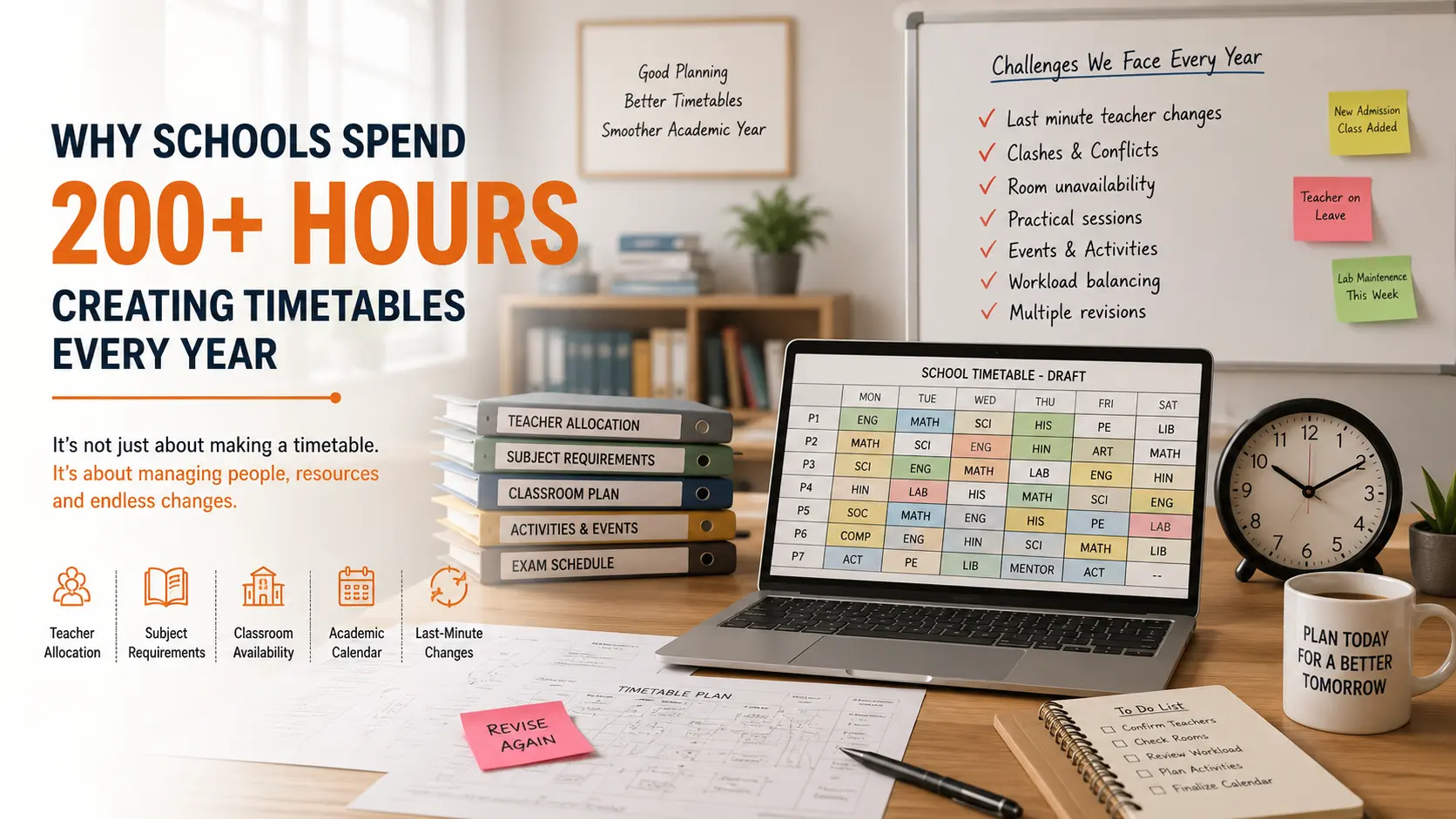
Why Schools Spend 200+ Hours Creating Timetables Every Year (And How to Reduce It)
Estimated Reading Time: 10 minutes
Every school creates a timetable.
Some finish it in two weeks. Others take more than a month. Many continue making changes even after classes have started.
If you've ever been involved in timetable preparation, you already know that the real work isn't just creating the timetable. It's handling everything that changes before and after it.
A teacher joins late.
Another resigns unexpectedly.
The Science department asks for one more practical session.
A classroom becomes unavailable.
A university circular changes the schedule.
What looked complete yesterday suddenly needs another round of revisions today.
Sound familiar?
If it does, you're in good company.
Schools across the country face the same challenge every academic year. Some have accepted it as "part of the process." Others simply hope that this year will somehow be easier than the last.
But here's a question we don't ask often enough.
Why does timetable preparation take so much time in the first place?
Most conversations focus on creating the timetable faster.
Very few focus on understanding why it becomes so complicated.
That's exactly what this article is about.
The Timetable Is Only the Final Picture
Walk into any school office and you'll probably see a timetable displayed on a notice board or pinned to a wall.
It looks neat. Organised. Complete.
Rows and columns.
Periods and subjects.
Teachers and classrooms.
From a distance, it almost looks simple.
But everyone involved in creating that timetable knows a different story.
That single sheet of paper represents weeks of discussions, dozens of meetings, hundreds of decisions, and more revisions than anyone cares to count.
The timetable is only the final picture.
The real work happens long before the first period is assigned.
Before a single class can be scheduled, someone has to answer questions like these:
- Who is teaching which subject?
- Have all teacher workloads been finalised?
- Which classes need laboratory sessions?
- Are enough classrooms available?
- Have school events been included?
- Are holidays and examinations already planned?
- Have new admissions been considered?
Every answer influences another decision.
That's why timetable preparation is much more than filling empty periods.
It's about bringing together people, resources, policies, and expectations in a way that actually works for an entire academic year.
Why We Keep Looking for the Wrong Solution
Whenever schools talk about timetable preparation, the conversation usually starts with tools.
Should we continue using Excel?
Should we buy timetable software?
Can Artificial Intelligence generate a better timetable?
These are reasonable questions.
But they're not the first questions we should ask.
Imagine you're building a new school building.
You wouldn't start by choosing the paint colour.
You'd first check the land, the design, the foundation, and the structural plan.
Timetable preparation works in much the same way.
The timetable is the final outcome of many decisions made weeks earlier.
If teacher allocations aren't clear, the timetable suffers.
If classroom planning is incomplete, the timetable suffers.
If workload expectations keep changing, the timetable suffers.
In other words, the timetable rarely creates the problem.
More often, it reveals problems that already existed.
That's an important difference.
Because once we understand it, we stop looking for quick fixes and start improving the planning behind the timetable.
A timetable doesn't create order.
It reflects the quality of the planning that came before it.
A Week Every Academic Coordinator Will Recognise
Let's imagine it's the first week of timetable preparation.
Monday begins with confidence.
Department heads submit subject requirements.
Teacher allocations are almost complete.
The academic calendar is ready.
Everyone believes the timetable will be finished in a few days.
By Wednesday, things begin to change.
One teacher requests a different schedule.
A new section is approved.
The laboratory timetable needs revision.
Someone notices that two practical sessions overlap.
By Friday, the team is no longer creating a timetable.
They're solving one problem after another.
No one planned for this.
It simply happened because every small change affected something else.
If you've experienced a week like this, you know how quickly timetable preparation can become stressful—not because anyone made a mistake, but because schools are living systems. Everything is connected.
And that's exactly why timetable preparation deserves far more attention than it usually receives.
The Hidden Cost of a Timetable
When schools talk about timetable preparation, they usually measure only one thing—how many days it took to complete.
"We finished it in three weeks."
"It took us almost a month this year."
"We had to revise it twice before reopening."
Those numbers tell part of the story, but they don't tell the whole story.
The real cost of timetable preparation isn't measured in days. It's measured in the hours spent discussing alternatives, reviewing teacher requests, checking classroom availability, solving last-minute conflicts, and making changes that ripple across the entire schedule. Much of this work happens quietly, often after regular school hours, when the rest of the campus has already gone home.
By the time the timetable is finally published, everyone feels relieved. Yet many schools know that the job isn't truly over. The first few weeks of the academic year often bring another round of adjustments.
The timetable may be complete.
The planning is still catching up.
Every Change Has a Ripple Effect
One of the reasons timetable preparation becomes so demanding is that nothing exists in isolation.
Imagine that a teacher informs the school she won't be available on Wednesday mornings because she has been assigned an external responsibility. It sounds like a simple request, and at first it appears that only one period needs to change.
In reality, that single change can affect several other parts of the timetable. Another teacher may now exceed the preferred teaching load for the day. A classroom that was free is suddenly occupied. A practical session has to move because the laboratory is no longer available. Students from another class may end up with two demanding subjects back-to-back.
Nobody planned for these problems.
They simply appeared because one decision influenced several others.
This is why experienced academic coordinators rarely describe timetable preparation as "filling periods." They know they are balancing people, classrooms, resources, policies, and expectations at the same time.
Behind Every Timetable Is a Team
It's easy to think of a timetable as the work of one person.
In reality, it is usually the result of many conversations.
Department heads confirm subject requirements. Teachers share their availability. The examination team highlights important dates. Management reviews academic priorities. Administrative staff update classroom information. Sometimes even transport schedules, sports activities, or cultural events influence the final plan.
Each discussion adds another piece to the puzzle.
This collaboration is one of the strengths of a school, but it also explains why timetable preparation takes time. Every decision needs to work not only on paper but also in day-to-day school life.
That's why experienced schools don't rush this process. They understand that a timetable created in haste often demands far more effort later.
The Impact Goes Beyond the Academic Office
A timetable affects far more people than the team preparing it.
Teachers experience it every day. A balanced timetable allows them to focus on teaching instead of worrying about exhausting schedules or unnecessary gaps between classes. Students benefit from a predictable routine, better use of laboratories, and fewer disruptions during the academic year.
Parents may never see the timetable itself, but they notice its effects. Frequent class changes, cancelled practical sessions, or repeated schedule revisions create an impression that the school is constantly reacting instead of planning ahead.
Even school leadership feels the impact. Hours spent resolving timetable issues are hours that could have been invested in teacher development, curriculum planning, student support, or new academic initiatives.
In that sense, the timetable is much more than a scheduling document. It quietly shapes the experience of almost everyone connected with the school.
Some Schools Seem to Handle It Better. Why?
If you've visited different schools, you've probably noticed something interesting.
Some schools appear calm during timetable season. Others feel as though they're in crisis mode.
The difference is rarely because one school has smarter teachers or better software.
More often, it's because the groundwork has already been done.
Teacher allocations have been confirmed. Subject requirements are complete. Classroom information is accurate. School events have been planned. Everyone is working from the same set of information.
When this preparation happens early, creating the timetable becomes much smoother.
When it doesn't, the timetable team spends its time chasing missing information instead of making good scheduling decisions.
That's an important distinction.
Good timetables don't begin with software.
They begin with good preparation.
A Different Way to Look at the Problem
For years, schools have asked the same question:
"How can we prepare the timetable faster?"
Perhaps it's time to ask a different question.
"How can we prepare our school better before we start creating the timetable?"
That small change in thinking makes a big difference.
Instead of treating the timetable as the starting point, we begin to see it as the result of hundreds of smaller decisions. When those decisions are thoughtful and well organised, the timetable becomes easier to prepare, easier to manage, and far less stressful to maintain throughout the year.
And that's where the conversation begins to shift.
The challenge is no longer just creating a timetable.
It's building an academic environment where the timetable can succeed.
Looking Beyond the Timetable
Here's something I've noticed after speaking with educators over the years.
Schools rarely struggle because people don't work hard enough.
In fact, the opposite is usually true.
Principals spend long hours reviewing plans. Academic coordinators patiently work through dozens of revisions. Department heads try to balance the needs of teachers and students. Administrative teams do everything they can to ensure classes begin on time.
The effort is never missing.
The challenge is that everyone is trying to solve the problem from the timetable onwards.
What if we looked at it the other way around?
What if we first asked whether the school was fully prepared before timetable preparation even began?
That small shift in thinking changes the conversation completely.
The Best Timetables Are Built Long Before They're Created
If you visit a school where timetable preparation feels surprisingly smooth, you'll often find that the real work happened weeks earlier.
Teacher allocations were confirmed.
Subject requirements were finalised.
The academic calendar had already been reviewed.
Laboratories and shared facilities were mapped carefully.
Special activities were planned in advance.
When the timetable team finally sat together, they weren't chasing missing information. They were making scheduling decisions with confidence because the foundation was already in place.
That's an important lesson.
The quality of a timetable depends as much on preparation as it does on the timetable itself.
A Different Conversation in the Staff Room
Imagine two schools preparing for the new academic year.
In the first school, the discussion sounds familiar.
"Can we move this period?"
"This teacher has too many classes on Thursday."
"The laboratory isn't available."
"We'll have to revise the timetable again."
Most of the conversation is about fixing problems that have already appeared.
Now imagine another school.
The discussion starts differently.
"Have we confirmed every teacher allocation?"
"Are practical requirements complete?"
"Is every classroom mapped correctly?"
"Have we reviewed our workload before creating the timetable?"
The timetable hasn't been created yet.
But many future problems have already been prevented.
That's the difference between reacting to issues and preparing for them.
Academic Operations Is Bigger Than the Timetable
A timetable is one part of a much larger picture.
Every academic year depends on hundreds of decisions working together.
Teachers need balanced workloads.
Students need a consistent learning experience.
Classrooms and laboratories should be available when they're needed.
School events, examinations, and activities have to fit into the same academic calendar without creating unnecessary disruption.
When these pieces work together, the timetable almost takes care of itself.
When they don't, the timetable becomes the place where every planning gap finally appears.
That's why I believe schools should spend as much time improving their academic planning as they do improving the timetable.
The benefits last throughout the year.
A Simple Health Check Can Save Weeks of Work
Think about how we approach other important decisions.
Before constructing a building, engineers inspect the site.
Before starting a major journey, we check the vehicle.
Before making financial decisions, businesses review their accounts.
Schools also deserve an opportunity to pause before the busiest planning season begins.
A simple review of teacher allocations, workload balance, classroom availability, laboratory usage, academic policies, and calendar planning can often uncover issues while they're still easy to solve.
Finding these gaps before timetable preparation begins is far less stressful than discovering them after the first day of classes.
It's a simple idea.
But it can change the entire experience of timetable season.
Good schools don't avoid problems.
They discover them early enough to solve them calmly.
A Question Worth Taking Back to Your School
Before your team begins preparing the next timetable, try asking a different question during your first planning meeting.
Instead of asking,
"How quickly can we finish the timetable?"
Ask,
"Are we ready to begin?"
That one question encourages a completely different discussion.
It shifts the focus from speed to preparation.
From solving conflicts to preventing them.
From managing another hectic timetable season to building a smoother academic year.
And perhaps that's the biggest opportunity of all.
Not creating a timetable faster.
Creating the conditions that make a good timetable possible.
Pause & Reflect
Before you move on to the next academic year, take a moment to think about the last one.
- How many times did your timetable change after it was published?
- Which issues came up again and again?
- Were those really timetable problems, or were they planning problems that surfaced later?
- If you had identified those issues earlier, how much time could your team have saved?
Sometimes, the best improvements begin with a simple conversation.
A Simple Academic Readiness Checklist
Before your team starts creating the next timetable, spend a few minutes reviewing these questions.
Teachers and Workload
- Have all teacher allocations been confirmed?
- Is the weekly workload balanced across the team?
- Have additional responsibilities been considered before assigning teaching periods?
Curriculum Planning
- Are all subject requirements finalised?
- Have practical sessions and electives been confirmed?
- Are there any curriculum changes that need to be reflected in the timetable?
Classrooms and Resources
- Are classrooms, laboratories and shared facilities mapped correctly?
- Have special rooms and activity spaces been planned in advance?
- Are there any resource constraints that need attention before timetable preparation begins?
Academic Calendar
- Have holidays, examinations and school events been included?
- Are important academic activities already planned?
- Has the calendar been reviewed by all concerned departments?
If you answered "Not yet" to several of these questions, don't worry.
Many schools are in the same position.
The important thing is to identify these gaps before they become timetable problems.
Questions We Often Hear
Is it normal for schools to revise the timetable after the academic year begins?
Yes. Almost every school makes some adjustments. The goal isn't to eliminate every change. The goal is to reduce avoidable changes through better planning.
Can software solve every timetable problem?
Software is an excellent tool, but it works best when the information going into it is accurate and complete. Good planning and good software complement each other—they don't replace one another.
Why do timetable conflicts keep appearing?
Many conflicts begin long before the timetable is created. They usually result from incomplete planning, changing requirements, or missing information that only becomes visible during scheduling.
Should schools review their timetable process every year?
Absolutely. Every academic year brings changes in teachers, student strength, curriculum, infrastructure and institutional priorities. Reviewing the process each year helps schools improve continuously instead of repeating the same challenges.
What is an Academic Operations Audit?
Think of it as a health check before timetable preparation begins.
Instead of waiting for problems to appear during scheduling, an Academic Operations Audit reviews the readiness of teacher allocations, workload balance, curriculum planning, classroom availability and other important areas. The purpose isn't to find fault. It's to help schools begin the academic year with greater confidence.
A Final Thought
A timetable may look like a grid of periods and subjects.
In reality, it's a reflection of how well a school has prepared for the year ahead.
When teachers have balanced workloads, classrooms are planned thoughtfully, practical sessions fit naturally into the week and academic activities have been considered in advance, the timetable becomes much easier to create—and much easier to live with.
That's why the most successful schools don't just invest time in creating better timetables.
They invest time in creating better academic planning.
The difference may not be obvious on the first day of school.
But you'll see it in the weeks and months that follow.
Fewer disruptions.
Less stress.
More time for teaching.
More time for learning.
And ultimately, a better experience for everyone.
About the Author
Pravin G. Dhuri is the Founder of TimetableAdmin, an Academic Operations Platform that helps schools, colleges and educational institutions improve timetable planning and strengthen day-to-day academic operations.
With decades of experience across banking, financial services, sales, marketing, training and entrepreneurship, he believes that good academic planning is not about adding more work—it's about making everyday work simpler, smoother and more meaningful.
Through the TimetableAdmin Knowledge Centre, he shares practical ideas, real-world observations and thoughtful guidance to help educational leaders build stronger academic systems.
Continue the Conversation
Every school has its own way of preparing timetables.
Some methods work well.
Some create unnecessary pressure year after year.
If this article reminded you of your own school's experience, perhaps it's a good time to take a fresh look at the planning that happens before the timetable is created.
That's exactly why we started the TimetableAdmin Knowledge Centre—to share practical ideas that help schools improve one step at a time.
If you found this article useful, we invite you to explore the other knowledge articles in this series and continue the conversation with your academic team.